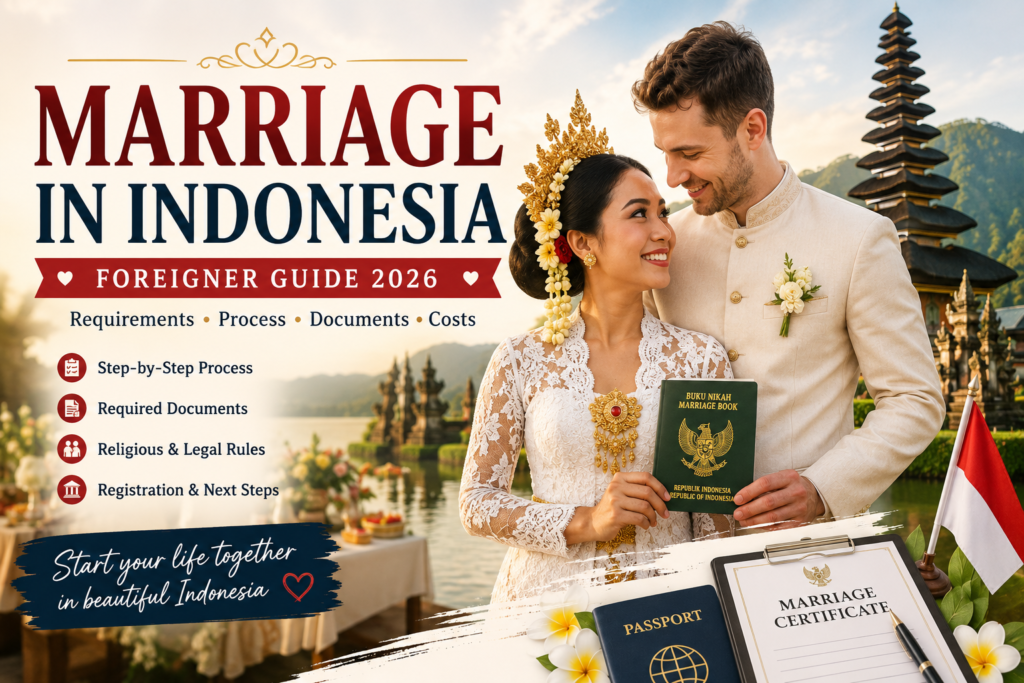
Getting married in Indonesia is a beautiful blend of rich tradition and specific legal steps. In 2026, the process remains rooted in the Marriage Law (No. 1 of 1974), which mandates that a legal marriage must be performed according to a recognized religion.
Here is a polite, step-by-step guide to navigating the journey from “engagement” to “legally wed” in the Emerald of the Equator.
Table of Contents
Step 1: The Golden Rule (Same Religion)
Indonesian law officially recognizes six religions: Islam, Protestantism, Catholicism, Hinduism, Buddhism, and Confucianism.
- Shared Faith: Both partners must profess the same religion. If you are of different faiths, one partner will generally need to officially convert to the other’s religion before the legal process can begin.
- No Secular Marriage: Purely civil or “non-religious” marriages are not recognized in Indonesia.
Step 2: Obtain the CNI (Certificate of No Impediment)
This is the most critical document for a foreigner. It is a letter from your home country’s embassy or consulate in Indonesia stating that you are legally free to marry.
- Requirements: Usually involves showing your passport and proof of singlehood (divorce decree or death certificate of a former spouse, if applicable).
- Validity: Most local offices require a CNI issued within the last 3 to 6 months.
Step 3: Gather the Paperwork
Bureaucracy is detailed, so having a complete dossier is vital. Ensure all foreign documents are translated into Indonesian by a sworn translator.
For the Foreign Partner:
- Passport: Valid for at least 6 months (though 18+ months is safer if applying for a stay permit later).
- Birth Certificate: Original and translated copy.
- Photographs: Usually 4×6 cm and 2×3 cm photos of the couple together, often against a red background (traditionally required for registry).
- Proof of Religion: A certificate or statement of your faith.
For the Indonesian Partner:
- KTP (ID Card) & KK (Family Card): Originals and copies.
- N1, N2, N4 Forms: Official “intent to marry” forms from their local village office (Kelurahan).
Step 4: The Religious Ceremony & Registration
The path splits depending on your faith:
A. For Muslim Marriages (KUA)
The ceremony and registration happen at the Kantor Urusan Agama (Office of Religious Affairs).
- The Result: You receive a Buku Nikah (Marriage Book). This serves as your legal proof of marriage; no further civil registration is required for it to be valid in Indonesia.
B. For Non-Muslim Marriages (Civil Registry)
This is a two-step process:
- Religious Ceremony: Performed by a priest, pastor, or religious official at a church or temple. They will issue a religious certificate.
- Civil Registration: You must report the religious ceremony to the Kantor Catatan Sipil (Civil Registry) within 10 days (though up to 30 days is sometimes allowed).
- The Result: They will issue an Akta Perkawinan (Marriage Certificate).
Step 5: The Prenuptial Agreement (Highly Recommended)
In Indonesia, married couples share joint property. However, foreigners cannot own freehold land (Hak Milik).
- The Risk: If you marry an Indonesian without a prenup, your spouse legally loses the right to own freehold land because half of it would “belong” to you.
- The Solution: A notarized Perjanjian Pranikah (Prenuptial Agreement) keeps your assets separate, protecting your spouse’s right to own property in their own country.
Summary Checklist for 2026
| Requirement | Action |
| Religion | Ensure both are the same recognized faith. |
| CNI | Get this from your embassy in Jakarta or Bali. |
| Translation | Use a sworn translator for all foreign docs. |
| KUA/Registry | Register within the legal timeframe post-ceremony. |
| Apostille | If using the certificate abroad, get it legalized/apostilled. |
You can apply for spouse KITAS visa after legally married in Indonesia. For details about visa, Please check Official Immigration Website and our guide Indonesia Spouse KITAS Guide for Foreigners (2026 Complete Guide)
To explore more, Visit the YouTube Channel Living Indonesia Official – YouTube
Book cheap flights, hotels ferries, trains, taxi at 12GO